About Us
Franco-Indian Campus at a Glance
The Franco-Indian Campus in Life Sciences for Health is a flagship initiative for bilateral cooperation, launched by the French government in 2022. It brings together 22 leading higher education and research institutions from France and India. Structured around four thematic consortia (BIOSANTEXC, Integrated Health, SHIELD, ILIADE), the Campus fosters interdisciplinary research and training in critical areas such as artificial intelligence, phytotherapy, public health, infectious diseases, neuroscience, and biomedical humanities.
AN INDOPACIFIC INITIATIVE
Empowering progress through cutting-edge technology and research, we bridge the gap between education and healthcare innovation with biotechnology and AI. The main objective of the Franco-Indian Campus in Life Sciences for Health is to build a long-term, structured and interdisciplinary cooperation between France and India in the fields of research, education, and innovation related to health and life sciences.
Launched under the auspices of the French government, this initiative stands as a testament to the strategic partnership uniting France and India. Bringing together more than sixty universities, research institutes, laboratories, hospitals, start-ups and leading corporations, it embodies the will of our two nations to jointly invest in the future of higher education and research in the life sciences for health.
Beyond the richness of its academic and scientific fabric, this project is also a diplomatic undertaking of the highest order. It reaffirms France and India’s shared vocation to act as driving forces of stability, knowledge and innovation in the Indo-Pacific region. In advancing together towards a comprehensive vision of health, our two countries proclaim to the world that the great challenges of our time—those that affect humanity, biodiversity and the planet itself—cannot be met without strong, confident, and visionary cooperation between sovereign partners.
At the heart of this initiative lies a pledge to youth, whose formation and opportunities will shape the future; to science, whose discoveries will open new horizons; and to innovation, whose breakthroughs will benefit all. By weaving education, research and development into a single fabric, France and India place their bilateral friendship at the service of global health, projecting a message of hope, solidarity and shared responsibility.
From Crisis to Cooperation
The Origins of the Franco-Indian Campus in Life Sciences for Health
The COVID-19 pandemic revealed with unprecedented clarity the fragility of health systems worldwide, reminding humanity of its profound vulnerability. In its wake, the call for bold, coordinated and visionary action in research, development and innovation has become inescapable. It is in response to this historic turning point, and in continuity with decades of dialogue and collaboration, that France and India envisioned the creation of a Franco-Indian Network of Excellence—a living alliance of knowledge, devoted to the advancement of life sciences and health.
More than a project, it is the weaving of a shared destiny: an enterprise uniting the scientific strengths of two great nations, forging bridges between universities and laboratories, hospitals and start-ups, governments and civil societies, across the vast expanse of the Indo-Pacific. This network does not merely aim to respond to today’s challenges; it aspires to shape the future of health itself, through the lens of innovation and the spirit of cooperation.
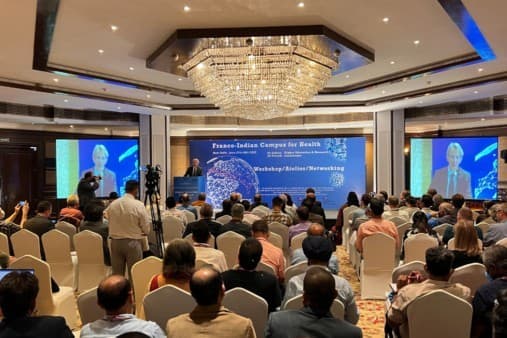
The journey began in April 2022 with a call for projects launched by France [Read here], to which the academic world responded with enthusiasm. Nine proposals were shortlisted, and soon after, in June 2022, New Delhi became the stage of an extraordinary workshop convened by the French Embassy. Over sixty institutions—forty Indian, twenty French—and more than a hundred researchers came together, meeting not as strangers but as future partners [Read here]. Out of this encounter, new consortia were born, embodying the creative spark of collaboration.
By October 2022, four projects had been selected to receive more than 900,000 euros in support from the French Ministries for Europe and Foreign Affairs and for Higher Education, Research and Innovation. This seed funding for the years 2023–2024 is already nurturing student and faculty mobility, new scientific workshops and events, and the dissemination of shared achievements.
The fields embraced by these projects are as diverse as they are vital: digital health, biotechnology, artificial intelligence for health, therapeutic innovation, holistic approaches to health, public health policy, pharmaceutical and natural product innovation, sports sciences, cancer, immunology, virology, antimicrobial resistance and neurosciences. Industry partnerships and start-up incubation add a further dimension, ensuring that discoveries travel beyond laboratories to transform society itself.
Yet this initiative looks beyond the present. Its long-term horizon is the creation of an academic ecosystem conferring Bachelor’s, Master’s and Doctoral degrees, closely linked with research and innovation. The immediate goal—dual Master’s degrees—marks the first concrete step toward a future where education, research and innovation advance hand in hand.
This endeavour is inscribed in the Horizon 2047 roadmap, celebrating a century of Franco-Indian friendship and cooperation. It has been further elevated by the Letter of Intent on cooperation in Health and Medicine, signed on 14 July 2023 during the historic visit of Prime Minister Narendra Modi to France, as guest of honour of the French national day [Read here].
Thus, the Franco-Indian Campus in Life Sciences for Health is not only a scientific project. It is a declaration: that in the face of global challenges, France and India choose to stand together, to build together, and to imagine together a future where knowledge serves humanity and health becomes a shared horizon.
Objectives of the Campus
Bilateral scientific cooperation
The Campus acts as a catalyst for Franco-Indian scientific collaboration, enabling the creation of long-term networks and high-value joint projects. By bringing together researchers, clinicians, and engineers across disciplines, it establishes a bilateral platform to jointly address major global health challenges, with a strong focus on innovation, applied research, and transversal collaboration.
Bilateral academic cooperation
Through the implementation of joint master’s degrees, PhD co-supervisions, summer and winter schools, and curriculum harmonization between France and India, the Campus strengthens academic dialogue. It builds a shared space of higher education where mobility, pedagogical hybridization, and mutual degree recognition exemplify a new generation of academic cooperation.
Student Mobility
The Campus plays a key role in increasing cross-mobility. It facilitates internships, research stays, shared academic semesters, and “6+6 months” schemes, enabling immersive and hybrid study pathways for dozens of students and PhD candidates from both countries each year.
Development of an interdisciplinary scientific ecosystem
The CFI positions itself as a hub of interdisciplinarity, bridging fundamental sciences, humanities, artificial intelligence, and engineering. It connects over 60 laboratories across its consortia, creating unique synergies between fields that are often siloed.
Strengthening ties between academia and industry
The Campus stands out for its ability to forge organic links between universities, research centers, and the private sector. Academic-industry workshops, partnerships with startups, biotech clusters, and clinical institutes help root academic research within innovation ecosystems that are both concrete and collaborative.
Professional integration
Thanks to research-based training and the inclusion of professional internships within laboratories and industries, the Campus enhances the employability of its graduates. Programs such as ILIADE incorporate entrepreneurship and industry placements directly into their curriculum, aligning education with health sector job market needs.