SHIELD PROJECT
Transformation of biosciences through digital technology and therapeutic innovations
Project Summary
Aware of the opportunities and challenges that Franco-Indian collaboration represents in terms of scientific and academic cooperation, Université Côte d'Azur has undertaken several actions, since 2017, to structure its relations with India. Building on pre-existing collaborations, the deployment of a Shield consortium able to radiate over the Indo-Pacific area is, thus, a logical continuation. The Shield consortium relies on:
1. Four main partners: three multidisciplinary institutions (Université Côte d'Azur, Ashoka University, IISc) and a specialised institution to strengthen the digital and health component (IIIT-Delhi) that have all built their training offer on thus encouraging and favouring the development of common trainings at a Master (on the principle of a Multi-Diploma) and PhD level, while opening to life-long learning.
2. Three geographical hubs that each rely on a strong Technopolis: Delhi (National Capital Region), Nice Sophia Antipolis and Bangalore.
3. A network of associated partners: national research institutions, incubators, clusters, hospitals, and companies led by the same ecosystemic vision to address the continuum between training, research, and innovation.
Project Description
In 2018, the Knowledge Summit held in India led to the signing of a mutual recognition agreement for degrees between the French and Indian governments, in the presence of Frédérique Vidal, Minister of Higher Education and Research. This agreement marks a real desire to further facilitate the pursuit of higher education by French students in India and Indian students in France and to promote their employability. This historic agreement is part of a broader framework of collaboration that is nourished by an excellent political relationship and a partnership between the two countries that is based on trust and reciprocity. Yet, in 2021, France had only 5,774 Indian students in mobility. Despite a strong increase (+91% in 5 years), France is only the eleventh country of destination for Indian students, far behind the United States (133,321 students). Inversely, the mobility of French students to India is, once again, far from reflecting the strong ties that bind our two countries. Indeed, France is only in 56th position in terms of students hosted in India (80 students for 2019).
1. Context and challenges
1.1 SHIELD: embedded in the University’s existing strategy
Aware of the opportunities and challenges represented by Franco-Indian academic and scientific collaboration, Université Côte d'Azur decided to conduct several actions to consolidate, develop and structure its relations with India. Thus, in February 2017, Université Côte d'Azur participated in the first "Ph.D. Tour" organised by Campus France and the French Embassy in India. The promotion of Université Côte d'Azur's PhD opportunities during the student fairs coupled with the meetings held with the heads of Indian institutions and universities allowed to explore possible areas of scientific cooperation.
Also, on the strength of an existing potential between several French and Indian research teams, Université Côte d'Azur organised an exploratory mission in 2018, co-organized with the French Embassy in India, to strengthen and structure existing or future cooperations. More broadly, this mission provided an opportunity to meet with officials from Indian institutions and companies to consider new strategic scientific partnerships and student mobilities. Following this exploratory mission, a first Indo-French Scientific and Training Workshop was hosted in Nice in 2019 to work on the structuring axis of cooperation between Université Côte d'Azur, the Indian Institute of Science (IISc), the International Center for Theoretical Sciences (ICTS), the National Center for Biological Sciences (NCBS) and the Tata Institute for Fundamental Research and the Raman Research Institute. On this occasion, agreements were signed at the institutional level including with the Indian Institute of Science Moreover, relying on the workshop, IDEX UCAJEDI and the participating Indian partners decided to provide financial support for the development of projects, including in the field of health. An investment of 107.840 € was made to support the development of 10 projects. Indian partners funded 50% and Université Côte d’Azur 50%.
Beyond scientific collaborations, these various actions have led to the increase in applications from Indian students (Master's, Doctorate level and microcredentials). Efforts still need to be made in terms of promotion which is why Université Côte d’Azur will continue de participation to the different study tours and fairs organised by Campus France (including to the next fair in October 2022).
1.2 The Shield consortium as a tool to increase mobilities between France and India in a balanced way
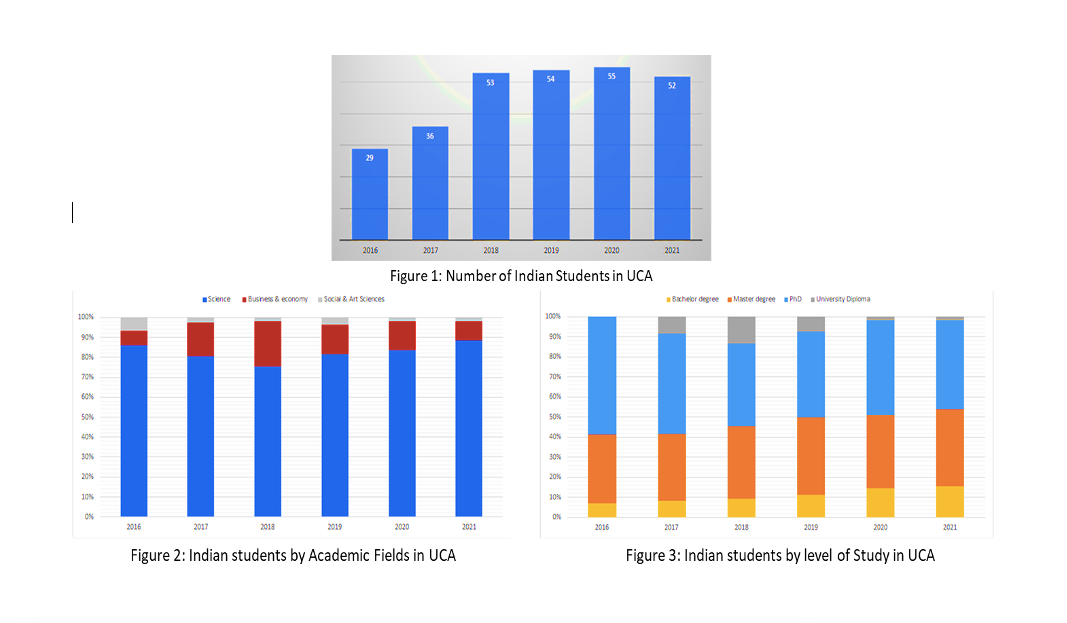
The increase in the mobility numbers highlighted in Figure 1,2 and 3 shows that the action undertaken produced a positive impact on the overall mobilities. However, these numbers are far from the potential we envision and especially, they only reflect mobilities in France.
The Shield consortium will be used as a tool to increase the number of mobilities to India and France. To do so, we have envisioned different mechanisms that should first and foremost motivate French students to come to India and Indian students to come to France.
These mechanisms include the organisation of summer and winter schools that will provide the opportunity for students to discover India or France for short periods of time, thus giving them a taste of what could be a longer mobility. Summer and Winter Schools will include cultural activities for students to embrace and better understand the Indian and French “way of life”.
Additionally, in parallel of the development of the Multiple Master programme, the partners will provide the opportunity of availing course credits (on the basis of microcredentials) relying on the modular content of the relevant customisable MSc programmes which will enhance the mobility of the French students to India and vice versa (see dedicated section).
Furthermore, the partners will open their laboratories, institutes, and research teams for master internships, PhD projects and staff exchanges for teaching and scientific collaboration. We are also strongly supported by our network of companies and institutions (see the support letters in annex) that will help to transform teaching and scientific outcomes in reciprocal opportunities for innovation and entrepreneurship.
1.3 The objectives of the Shield consortium
The Shield consortium relies on a clear signature:
· Geographic coherence: Bangalore, Delhi and Nice are recognized as strong innovation hubs supported by high-level scientific parks with an international outlook.
· Common approaches: training through research, interdisciplinary approach, intensive research, and links with the civil society (participatory science).
· Common values and commitment: all partners have committed to gender equality and have developed a policy to ensure inclusiveness
· An experimentation phase focused on two main fields, before deploying other topics. The particularity of both topics, described below, is their novelty and transdisciplinarity, which implies not only to train new generation of Life Scientist, but also to provide these new knowledges to experts in the field working for companies and other institutions. Thus, beyond the development of initial training, it will favour the development of lifelong training through micro-credential.
1.3.1 The transformation of biosciences through digital technology.
Life Sciences are witnessing a new scientific revolution in which both the resolution and the volume of data, at all biological scales, grow in an unprecedented manner. To give two examples, at a planetary scale we can now identify nearly exhaustively species in an ecosystem, using biological sampling and extensive sequencing. In parallel, the intensive deployment of CryoEM and machine learning tools such as Alphafold now enable to obtain a plethora of atomic scale macromolecular structures. Yet, scientific excellence now relies on generating, processing, and integrating complex, massive and multiscale data, of very different nature. This requires sophisticated approaches, from modelling to machine learning, that are not in the standard culture of most biologists. We therefore need to train a novel generation of Life Scientist, who will, both, not be afraid of daring experimental procedures, and, handling complex datasets.
For this topic, the learning outcomes that will emerge from our Shield consortium project are the tools and knowledge to perform multiscale analyses of complex biological system by processing and modelling large and/or complex datasets, from molecules to ecosystems. This will require to train very solid biology students in mathematical modelling (e.g. statistics, calculus tools, differential equations, discrete maps and dynamic systems, topology, polynomial systems, networks etc…), physics (e.g. out of equilibrium thermodynamics, force fields, advanced physicochemistry for living systems, optics and photonics etc…) and in sophisticated computational approaches (e.g. statistical computation, machine learning, simulation etc…). For this we will exploit the great complementarity between our programmes notably the IIITD Master in Computational Biology Programme as well as specific modules offered by Ashoka and IISC, and Université Côte d’Azur Bioinformatics and Computational Biology Master Track as well as the courses offered by its 3IA Artificial Intelligence Institute. This will enable our Shield consortium to offer its students a unique combination of modules and internship opportunities, such as described in the use Case 1 in section 4.
1.3.2 From molecular mechanisms to therapeutic innovation
Therapeutic innovation is one of the most exciting fields that emerge from the tremendous pace of discoveries witnessed by Life Sciences in the past decades. One of its most spectacular trends can be summarized by the fact that therapeutic agents see their size drastically increasing. While most pharmaceutical molecules that are on the market (and in our homes) are composed of ~20 to 50 atoms, we recently saw the arrival of much larger assemblies in the order of 103-104 atoms such as monoclonal antibodies or RNAs. These numbers will continue to increase exponentially with the arrival of viral (~106-7 atoms) and cellular therapies (>1014 atoms). Such an increase in complexity for these innovative therapeutic agents poses numerous challenges both to scientists and industry. Those pertain of course to the biological mechanisms involved, to safety, but also to regulatory procedures, intellectual property, scalable mass production, conservation/shipment, or ecological sustainability in all the production and utilization chain. The COVID crisis also showed that one unexpected limit could be the patients’ acceptance of novel and complex therapeutic agents, leading to the idea that pedagogy is also a key challenge.
We identify this field as in great need of extremely well-trained future specialists. The main learning outcome that we intend to achieve is to provide the students with a very clear mechanistic view of structural biochemistry, kinetics and pharmacology, which are the basics to understand and quantify ligand- target interactions. This of course must be completed by excellent notions in toxicology and pharmacokinetics. Furthermore, based on evolution in the field, what is now required is excellent training in biotechnology- bioengineering, immunology, virology, cell biology and of course pathophysiology. Students may also want to acquire advanced statistics, chemistry, computing, screening strategies, learn about medical devices, or specialize in entrepreneurship, intellectual property, regulatory aspects, and even get introduced to social sciences. As mastering such a plethora of fields is beyond range during a Master or a PhD duration, training in Therapeutic Innovation is by essence modular and to some extent interdisciplinary. This fits particularly well with the architecture of the proposed Shield consortium, because we gathered a rare mix of very well-designed programs with complementary modules that cover the above-mentioned wide spectrum among the different partners, especially in Ashoka, and IISC. As examples, please see “Use case 2: Université Côte d’Azur and Ashoka University focusing on molecular mechanisms towards therapeutic innovation with a general orientation” and “Use case 3: Université Côte d’Azur and IISc focusing on molecular mechanisms towards therapeutic innovation with a focus on Cancer”
Finally, each partner has excellent laboratories in the field, is associated with a very visible Technopolis where it has built a privileged network of partners and companies (see support letters). The campus will benefit from their unique pharmaceutical expertise to conceive programs from bench to market in this very rapidly growing field. Reciprocally, we can propose companies both fundamental training modules and workshops as well as great internationally trained students for internships and future jobs.
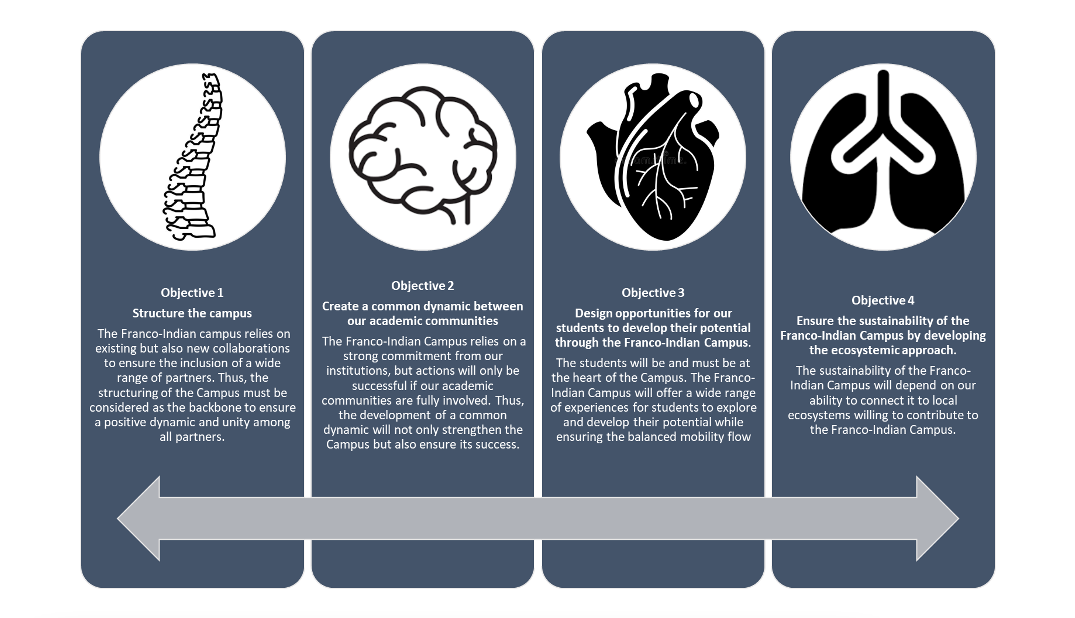
The creation of a Shield consortium is therefore a logical continuation of the actions undertaken by the Université Côte d'Azur in association with its Indian partners, while at the same time consolidating the training-research continuum. To do so, the partners have set four main objectives:
2. Main achievements at the end of the project and 5-year vision
Eventually, the Campus will be based on the following elements:
§ Multiple Degree at a Master's level
§ Micro-credentials that can be opened to non-academic partners, companies
§ A transdisciplinary and intersectoral Doctoral Academy
§ A specific mobility programme for students (including internships) supported by the respective technopole companies
§ A specific mobility programme for academics
§ A joint programme to develop the entrepreneurial spirit of students and young researchers
§ A brand image to make the Campus visible, including throughout the Indo-Pacific region. This image will be based on an Alumni network (Ambassadors programme) and integrated into the existing Campus France Alumni network.
That being said, under the guidance of the Université Côte d'Azur, which has extensive experience in the development of bi-national campuses, the consortium agrees that a gradual and experimental approach that will allow for the establishment of a solid foundation will ultimately guarantee the sustainability of the Campus. We therefore identify two main phases.
2.1 Phase 1. Building of the Campus and launch of pilot projects (Year 1 and 2)
This first phase should allow us to concretely engage in the work of co-construction, relying first and foremost on our academic communities and in connection with the socio-economic actors of our respective territorial hubs. To this end, our communities will be called upon to refine the thematic orientations of the Campus and develop the various programmes that will bring the Shield consortium to life: initial training, doctoral training and lifelong training. Although supported by the pedagogical engineers, a great deal of work will be required to pool the models and build programmes:
§ Coherent and complementary
§ Meeting the needs while relying on the expertise
§ Legally accepted in India and in France
§ Irrigated by research
§ Including the internship dimension in the laboratory but also with socio-economic actors
To reach this objective, workshops (at least 4 onsite for teams to meet in person) will be organised in France and India, led by the academic community. Also, beyond the thematic building of the academic curricula, the workshops will also focus on transversal modules such as, but not limited to, entrepreneurship, open data, etc.
- Workshop 1: Integration of fundamental biology discoveries with health science (led by Ashoka University and CNRS)
- Workshop 2: Quantitative basic and applied Biology (led by Ashoka University)
- Workshop 3: Data challenges in Biology and Artificial Intelligence (led by IIIT-Delhi and Inria)
- Workshop 4: Application of Biotechnologies to novel therapeutic approaches (led by UCA and Inserm)
- Workshop 5: Ethics (UCA)
- Workshop 6: Therapeutic Innovation from fundamental to applied (led by IISc and Associated partners: Hospitals)
- Workshop 7: Entrepreneurship and deeptech: from the idea to the start-up (IIIT-Delhi and the Chamber of Commerce)
- Workshop 8: The new generation of Life Scientific: employability and needs (Associated partners: incubators and companies)
These workshops are crucial as they will allow our research communities and non-academic partners to develop strong connections leading to the development of scientific collaborations. Indeed, for each of the two thematic that will be experimented, Horizon Europe proposals can be matched to fuel the scientific collaboration and strengthen the continuum between research and training.
Beyond the creation of new contents, we will also immediately make excellent use of the modular construction of the training offer, shared by all partners, which is a major asset for this pooling exercise (see Use-Case 1, 2 and 3 in section 4). These use-cases should be understood as the evidence that we are able to immediately start exchanging students and are therefore fully configured to reach our goal of mobility.
In parallel with the creation of contents, the first two years must allow the design of tools and programmes that will promote the deployment of the Campus: mobility and scholarship programmes (in connection with the socio-economic stakeholders), an entrepreneurial programme and a digital Campus platform. While certain tools already exist: Erasmus + International Mobility, IDEXJEDI Visiting Professors Programme, IDEXJEDI Student Scholarships, EUR Master Mobility Scholarship, CEFIPRA (master's internship, training schools), Charpak Programme, the Shield consortium should make it possible to go further by making the existing tools coherent to make them easier to read and to have a leverage effect on other opportunities (industrial scholarship programme, Horizon Europe, etc.). In addition, discussions will be initiated so that Campus France can manage student scholarship programmes according to the usual procedures, and thus, facilitate their execution and implementation.
Finally, a third component will consist of building the Campus' brand image and communication strategy in order to maximize student flows between France and India. For this, the consortium will benefit from the support and expertise of Campus France. In addition to raising awareness of the Campus, one of the challenges will be to make Indian students aware of the opportunities to study in France:
§ Indians about the opportunities to study in France, where they traditionally turn to English-speaking countries
§ French students about the opportunities to study in India, where they may be worried about the idea of studying in a country as large as India
2.2 Phase 2. Years 3 to 5. Consolidation of the Campus and replicability of pilot projects
At the end of the two years, we will have created a favourable ecosystem for the second phase, which will unfold from year 3 to year 5. First, the consortium will expand the thematic perimeter to include other themes related to health sciences, but always with a pilot approach to ensure that the academic community is on board on both the French and Indian sides. Also, we recommend that the expansion of the perimeter be done in a concerted manner with the other selected Shield consortium to create a complementarity that will reinforce the signature and visibility of the Franco-Indian training offer.
In addition to broadening the thematic scope, it will be necessary in Year 3 to ensure the geographic expansion of the Campus by deploying the Shield consortium more widely and thus promoting its influence throughout the Indo-Pacific region. This geographical expansion could also be accompanied by the inclusion of new main partners wishing to join the dynamic. To this end, the consortium plans to intensify its strategy of promotion and dissemination of training offers, through the implementation of a caravan dedicated to the entire Indo- Pacific region (or relying on the Study Fairs organised by Campus France). This intensification will be made even more possible by the fact that, at the end of year 2, the partners will have completed the construction of a Multiple Diploma Master and several micro-credentials courses, which will constitute a strong additional option, beyond the classic mobilities. Specific promotion events will be conducted to attract young talented women in the programmes offered by the Shield consortium especially in the streams focusing on the digitalisation of biosciences, as we still observe a very unbalanced ratio in ICT disciplines (in France and in India). This commitment, aligns with already existing commitments shared by all partners (example: activities led by IIIT- Delhi resulted in a highest gender diversity ration on their campus than the national other technical institutions) At the same time, by the end of Year 2 and in view of Year 3, the sources of funding necessary for the sustainability of the Campus must be identified and set in motion:
§ The structuring of the Franco-Indian community on the pilot themes adopted in Year 1 will have reached a sufficient level of maturity to submit responses to European and bi-national calls for projects. In this respect, the consortium plans to focus initially on the instruments of the MSCA programme which covers career development, mobility, and international cooperation, including the non-academic sector.
§ The consortium will have forged sufficiently strong links to propose a training offer adapted to the socio-economic fabric according to the needs of the actors and the expertise of the different partners of the consortium, thus generating additional funds.
§ The partners will work on the development of scholarship programmes relying on the associated partner companies and clusters.
The shared vision at the end of the five years is to have established a Campus capable of spreading throughout France and the Indo-Pacific region. As a showcase for the academic and scientific cooperation between France and India, the Shield consortium will act as a relay, while relying on local operators such as Campus France, CEFIPRA, the Chamber of Commerce, etc. The Campus will become a key player in relations between France and India and will help to intensify:
§ Student exchange flows in a balance way
§ Cooperation in research, including through doctoral training
§ Relations with the socio-economic fabric, particularly with industries located in the respective partners’ Technopolis
Although the consortium will reach a cruising speed at the end of the 5 years, it is convinced of the importance of continuing to organise events in order to maintain the momentum and reinforce the attractiveness of the Campus.
3. The Consortium
The Shield consortium will illustrate the ecosystemic approach shared by all partners:
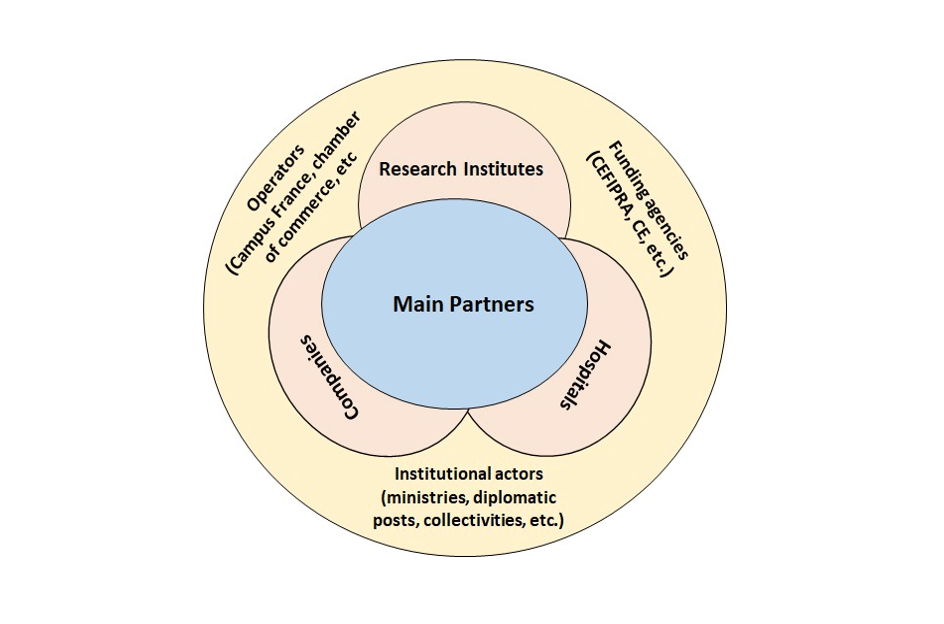
§ A first circle with the lead partners covering training, research, innovation and service to society: Université Côte d'Azur, IISc, Ashoka University, IIIT-Delhi
§ A second circle comprising associated partners who are committed to contributing to one or more activities: CNRS, Inria, INSERM, Hospitals, clusters/ incubators and companies (see letters of commitment).
§ A third circle comprising the actors on whom the consortium will rely during the deployment and execution phase of the Campus: Campus France, Chamber of Commerce (see letter of commitment), diplomatic posts, etc.
Beyond a strong existing partnership with the IISc and thanks to the support of the Embassy, Université Côte d'Azur was able to forge new links with institutions whose model and values are similar to our own:
§ Strong territorial anchoring and solid links with the socio-economic fabric
§ Inter- and trans-disciplinary character in line with the main socio-economic issues
§ Modular training that allows students to build their training path regarding their career development plan (see the examples in the previous section)
§ Research intensive and strong continuum between research, training and innovation
Moreover, as the ecosystemic approach is fundamental, we have favoured the construction of the Campus relying on three Technopolis representative of the quadruple helix (government, academia, industry, and community): the Nice Sophia-Antipolis, Bangalore, and Delhi. This approach will allow us to promote the inclusion of the socio-economic fabric in the development of activities and in particular:
§ Cluster and incubators
§ Companies
§ Hospitals
With a view to consolidating the consortium, Université Côte d'Azur carried out a complementary mission in July 2022 to visit the sites of each of the partners and validate with them the main axis of the Campus and ensure the feasibility, including the logistics of implementation (infrastructure, housing, transport, etc.).
3.1 Université Côte d'Azur
Université Côte d'Azur was created in January 2020 as an experimental university. It has been awarded the major national label of "IDEX" initiative of excellence, which positions it among the 9 French "IDEX" universities with intensive research and strong international influence. Structured into innovative internal components with increased responsibilities for greater agility, Université Côte d'Azur backs all of its training and innovation missions with the excellence of its research. Its strong roots in the Côte d'Azur region makes it one of the driving forces behind its growth model. As a founding member of the Ulysseus European alliance, and as the holder of one of France's four Interdisciplinary Institutes for Artificial Intelligence (3IA), Université Côte d'Azur has established partnerships with major national research players and intends to position itself among the best European universities and consolidate its international dimension. The development of the training, research and innovation continuum largely echoes the transformation of the Université Côte d'Azur site, which has opted to create Graduate Schools (Ecoles Universitaires de Recherche or EURs in French) whose objective is to strongly associate training with research and the socio-economic sector, to encourage transdisciplinary approaches and to stimulate innovation. The Shield consortium will more specifically rely on the LIFE Graduate School, which focuses on Life and Health Sciences.
Université Côte d’Azur LIFE and Health Sciences (LIFE) Graduate School is using a bold transformative process to reach the best international standards in the teaching Life Sciences at the highest level on its territory. For this it uses first it’s very strong research environment to build novel and innovative curricula. LIFE gathers 9 research institutes and laboratories (more than 80 teams) bringing together on 3 campuses a total of about 1,000 researchers and 1,200 students, from Bachelor to PhD. These laboratories are under the supervision of UCA, CNRS, INSERM (who are here partners of our Shield consortium Project), INRAE, CEA, INRIA. The EUR LIFE integrates the SV (“Sciences de la Vie”) PhD school and the two LABEX SignaLife and ICST. LIFE laboratories are renowned for their seminal contributions in various fundamental research fields of life Sciences (Cell biology, Development, Genomics, Neurobiology, Pharmacology, Plant Science, Ecology) as well as in major diseases and environmental issues like cancer, diabetes, neurological disorders, inflammation, or parasitic processes, in close interaction with the University hospital (CHU de Nice). The excellence of this biology community is attested by prestigious medals, prices, academies memberships and international rankings that place Université Côte d’Azur Life Sciences at top positions when normalized by size.
In parallel to its biological excellence, the site has an international recognition in mathematics, physics and computing, notably with the award of the 3IA artificial intelligence label that has two of its four pillars on “AI for computational biology” and “AI for Integrative Computational Medicine”. All these disciplines are strongly linked by the IDEX and the creation of Université Côte d’Azur which is by nature interdisciplinary and of human dimension. To ensure a strong outcome on innovation and entrepreneurship in the Biotech/Medtech sector, LIFE is also in strong interaction with SKEMA business school hosted at the Sophia-Antipolis Technopole, the Université Côte d’Azur Innovation center for Entrepreneurship and the Management Center Innsbruck which is a partner of Université Côte d’Azur Ulysseus International alliance.
3.2 Ashoka University
Ashoka University, founded in 2014, is India’s first research university that offers an integrated, multidisciplinary Liberal Arts and Sciences programmes. The vision of Ashoka carries a strong emphasis on foundational knowledge and hands-on experiences with real-world challenges. With a high student to faculty ratio, students have ample opportunity to learn from some of the finest minds in the country and the world. The mission of Ashoka is to bring people with different interests and expertise onto the same platform to carry out focused research. One of the primary focus areas of Ashoka is health and diseases. In less than 10 years Ashoka University has risen to the top rankings in multiple categories the QS(Asia) rankings and is expected to be at the forefront of education and research in the foreseeable future. The department of Biology is the largest in the Sciences programme that was launched in 2017. The department fosters multi-dimensional approaches to study biology across various scales ranging from molecules to cells, tissues to individuals and organisms to ecosystems. The department also draws expertise from disciplines like Chemistry, Physics, data sciences, climate & environmental sciences, social sciences, and humanities. The Department of Biology also hosts the Trivedi School of Biosciences (TSB) that aims to perform high quality research in the areas of Disease Biology, Inflammation Biology, Synthetic Biology, Bioinformatics and computational biology, Health Analytics and Data Science. Other centers of peripheral relevance include the Center for Climate Change and Sustainability (3CS), and the Interdisciplinary Archeological Research (CIAR). Ashoka University also holds MOUs with various hospitals for access to health data and samples for research and analytics purpose. Letter from one such major collaborator hospital is included. Ashoka is known for its world class faculties for research, training, and teaching. The faculty of the biology department include multiple recipients of highest science awards in India, Shanti Swarup Bhatnagar award and various levels of the prestigious DBT-WellcomeTrust India Alliance awards, and current President of the International Union of Biological Sciences (IUBS), Swarnajayanti Fellowship etc. In addition, Ashoka physics and chemistry faculty complement biology faculty in research on diseases, faculty of history study history of diseases and medicine and faculty in the Economics department study health economics and public health policies. Significant number of Ashoka students secure higher education opportunities in various leading universities in the US, Europe and other countries. Students also engage in clubs and societies to contribute and enrich their campus experience culturally and intellectually, ranging from music, dance and gaming to community engagement, language, creative writing, photography etc. Ashoka University provides world class facilities including air-conditioned residential halls and extensive arena for indoor and outdoor sports.
3.3 The Indian Institute of Science (IISc)
The Indian Institute of Science (IISc) was established in 1909 by a visionary partnership between the industrialist Jamsetji Nusserwanji Tata, the Mysore royal family and the Government of India.
Over the last 113 years, IISc has become India’s premier institute for advanced scientific and technological research and education. In 2018, IISc was selected as an Institution of Eminence (IoE) by the Government of India. It also consistently figures among the top Indian institutions in world university rankings – it was most recently ranked as the world’s top research university in the citations per faculty metric of the QS World University Rankings–2023, and as the No. 1 university in the National Institutional Ranking Framework (NIRF)- 2022.
IISc’s research output is diverse, interdisciplinary and cuts across traditional boundaries. The Institute has over 42 academic departments and centres that come under six divisions. It also places equal emphasis on student learning, with about 4,000 students pursuing several postgraduate and doctoral programmes, and a Bachelor of Science (Research) programme as well as a newly introduced undergraduate (BTech) degree in mathematics and computing. Most recently, IISc has embarked upon setting up a Postgraduate Medical School along with a multi-speciality hospital in its Bengaluru campus, a historic endeavour that aims to create a new generation of physician-scientists in the country who will be trained simultaneously in the hospital as well as the science and engineering labs of the Institute.
The Indian Institute of Science (IISc) offers three Masters’ programmes based on course work: Master of Technology (MTech), Master of Design (MDes) and Master of Management (MMgmt). IISc admits about 450 students every year for its course programmes, and about 50 sponsored candidates from various government agencies and public sector units (PSUs). The Institute also offers an MTech (Online) programme for working professionals from companies that have an agreement with IISc. IISc also offers an MTech (Research) programme designed to prepare students for advanced engineering practice through research, development, production, design and/or management. Each student works on an independent research project with a research advisor, and plans a programme of course work and thesis research. In 2022, the Institute introduced a new Master’s degree programme (MSc) in the Life Sciences and Chemical Sciences streams.
3.4 Indraprastha Institute of Information Technology Delhi (IIITD)
Indraprastha Institute of Information Technology Delhi (IIIT-Delhi) was created by an act of Delhi legislature empowering it to carry out R&D, conduct educational programs, and grant degrees. The General Council is the apex body of the Institute, chaired by Hon'ble Lt. Governor of Delhi and the Board of Governors is the policy and decision-making body of the Institute. The Senate is empowered to take all academic decisions.
IIIT-Delhi is accelerating on the path of becoming one of the leading comprehensive research-led teaching institutes in India and has proven to be consistently responsive towards the evolving needs of society. The faculty members at IIIT-Delhi are among the finest in the country and are internationally recognized. Carrying out cutting-edge research is in the institutional DNA of IIIT-Delhi. It ranks among the top 10 Computer Science Departments in India in CSRanking and in top 100 in NIRF rankings.
IIIT-Delhi has six academic departments - Computer Science and Engineering, Electronics and Communication Engineering, Computational Biology, Human-Centred Design, Mathematics, and Social Sciences & Humanities. Its research centers include the Infosys Centre for Artificial Intelligence, Centre for Computational Biology, Centre for Design and New Media - supported by the TCS Foundation, Centre of Technology in Policing, Centre of Sustainable Mobility, Centre of Excellence for Lifi/VLC, and Centre of Excellence in Healthcare.
The Institute takes pride in maintaining a green campus and has been awarded the AICTE clean and smart campus award three times in a row. IIIT-Delhi has a built-up area of 100,000 square meters. This includes a modern Seminar Block, R&D Block, state-of-the-art classrooms, research labs, a Library and Information Centre, Incubation Centre, newly constructed hostels for boys and girls to accommodate 1800+ students, dining and student activity centre with multiple eateries including a 24-hour canteen, and Faculty residence blocks. The campus also has a multipurpose playing field, a gymnasium, indoor badminton and squash courts, outdoor tennis courts, basketball and volleyball courts, and an indoor swimming pool. The campus incorporates several green-building features and is GRIHA rated, zero-discharge campus with sewage treatment plants, rainwater harvesting, heat pumps, and solar power plant on terraces of all new buildings.
IIIT-Delhi recently set up the Technology Innovation Hub (TiH), under the National Mission on Interdisciplinary Cyber-Physical Systems. This Technology Innovation Hub is focussed on catalysing state-of-the-art research, development, technology transfers, engagement with industry and entrepreneurial activities. IIITD is also a part of the Delhi Science and Technology cluster and is addressing some of the hyperlocal problems through research.
The Institute has a healthy innovation ecosystem leading to entrepreneurship. The IIITD-Incubation Centre is instrumental in driving growth of entrepreneurial activities at IIITD campus, including providing incubation support, funding, infrastructure, mentoring etc. to students, faculty members and alumni of the Institute. The Incubation Centre is supported by funds from DST, MEITY, and the Delhi government.
IIIT-Delhi is committed to playing a leadership role in research, teaching and entrepreneurial activities, both regionally and nationally, and in defining, shaping, and inventing a better tomorrow.
4. Training courses and activities
4.1 Training courses
The different programmes that have been developed and learned to run also online (thanks to the COVID crisis) are fully operational and will be fully used as a platform for building the present Shield consortium. While we will open the full spectrum of our teaching modules to our Indian partners and reciprocally, our students will be able to move rather easily to Delhi, Bangalore and Nice as they are trained to build their own training by choosing a set of teaching units in a modular manner
4.1.1 Master Programmes
After discussions with the Indian partners and in the interest of credibility and feasibility, it seems unlikely, for regulatory reasons, that a single joint master’s degree can be developed. On the other hand, it is perfectly possible to create a multiple degree that will be awarded bilaterally by Université Côte d'Azur and one of the Indian partners. In this way, there will eventually be three possible accreditation courses:
§ Université Côte d'Azur - IISc
§ Université Côte d'Azur - Ashoka University
§ Université Côte d'Azur – IIT-Delhi
The following Master programme will be used as references:
Master Programme of Science, Université Côte d’Azur
LIFE steers a highly selective modular Master that is composed of 40 teaching units that can be combined to compose five tracks (10/track, see annexes): Bioinformatics and Computational Biology (BBC); Cancerology and Translational Research (CRT); Genetics and Development (GD) Cellular and Integrated Neurosciences (NCI). Physiopathology and Pharmacology (P3). While a set of 5 units is mandatory for each track the students avec a large choice among the others to become actors of their own curriculum. This modularity and the presence of two large internships (5 and 6 month respectively) in M1 and M2 make this Master a very well rated and appreciated diploma. Over the 2019-2022 period, the median number of master's students grew from 80 to 130(M1 + M2), while keeping the same strong selection rate, due to an explosion of candidatures that reflects our attractivity.
Master Programme in Life Sciences and Chemical sciences, Indian Institute of Science
In 2022, the Institute introduced a new master’s degree programme (MSc) in the Life Sciences and Chemical Sciences streams. These two-year degree programmes consist of foundational and flexible coursework and hands-on laboratory training. The design is aimed to develop experimental skills in advanced techniques for research, leading to an independent thesis research project. Students enrolled in the MSc programmes can personalise their coursework and research projects.
Master Programme in Biology, University of Ashoka
Ashoka University currently offers masters is Biology, Economics, English, Liberal Studies, and a special Young India Fellowship for multidimensional learning to build emerging global leaders. The Master in biology programme at Ashoka University imparts holistic training in the fundamentals of physical and chemical principles of biology, in diverse yet connected areas ranging from evolution and organismal biology to cell- molecular and computational biology. This unique programme allows talented and motivated students (from any country) to customize their specialized learning based on individual interests. Students will learn through hands-on training aided by contemporary and innovative pedagogical methods as well as through extensive independent research. The course curriculum spans over 2 years with 4 semesters. In year 1, customized specialization is achieved from a wide range of elective courses spanning biophysics, biochemistry, cell and developmental biology, computational and mathematical biology, behaviour, ecology, and evolutionary biology as well as any relevant course from any other disciplines taught at Ashoka including those from chemistry, physics, math, computer science, economics, creative writing, archaeology, entrepreneurship etc. In year 2, thesis research is performed in an identified area of specialization within or outside the university (in academia or industry). International collaborative research for a maximum of 6 months is allowed as a part of the thesis undertaken. Optional summer courses and field courses are also offered. The students can also obtain some credits from other Universities (national or international) towards building their specialization. Therefore, the modular course structure allows ample flexibility for creating new tracks based on the student’s interest. Importantly, international students can spend around 7 months at Ashoka to finish the first year of credits and complete the research credits at their home country. The above features will support bidirectional student mobilization at various levels.
Master Programme in computational biology, IIITD
The Masters in Computational Biology Programme at IIITD stitches together molecular biology, genomics, algorithms, programming, statistical computation, machine learning, stochastic processes, and other mathematical techniques that underlie biological design principles. The programme also has offerings from courses in healthcare such as Computing for Medicine (BIO546/CSE585) and Healthcare Innovation and Entrepreneurship Essentials (ENT421/BIO571). In the M.Tech CB program, the student currently do 32 credits of course work and 16 credits for a Thesis, for a total of 48 credits. From the 48 credits, a minimum of 20 credits of coursework are required from courses in Computational Biology. In electives, at most 4 credits of “Independent Study/ Project” can be taken and all students have a mandatory requirement to do a thesis in Computational Biology. Additionally, an intensive preparatory course is conducted for a month every year, before the onset of the first semester for a new M.Tech. batch of students, which includes the following three components: Biology, Mathematics and Programming and Data Structures. Additionally, IIITD has a Center of Excellence in Healthcare (CoEH), with a vision to be a catalyst for digital transformation of healthcare through research, teaching and entrepreneurship. The mission of the CoEH is to achieve accessible and affordable, and accountable healthcare for all by bringing data and intelligence to the point of care. The CoEH brings together a cross-departmental collaboration from faculty working in Computational Biology, Computer Science, Design, Electronics and Communications Engineering and Entrepreneurship to create research and implementation solutions. The CoEH has received funding from the central and state funding agencies, in addition to industry funding support and has strong collaborations with apex hospitals organizations of the country such as All India Institute of Medical Sciences, New Delhi and the Indian Council of Medical Research. CoEH contributed numerous solutions to the management of COVID-19 pandemic in the country. These include the Delhi Government's official app for COVID-19 (Delhi Corona) and an AI based Genomic Surveillance model, StrainFlow, for predicting surges across 17 countries. StrainFlow effectively forecasted all four waves, each two months in advance in India. In addition, the CoEH has contributed solutions for hospitals such as AI based mortality risk prediction in cardiovascular diseases and consensus based risk scoring calculator for multiple myeloma
More concretely, please find below three use-cases building up of the modularity of the different Master Programmes. Please be aware that these use-cases are only examples of pathways that could be followed by an Indian or a French student. Indeed, and this is an important factor of our Shield consortium, each student gets the opportunity to build its own pathway in accordance with his or her professional project. Keeping this in mind, what will be fundamental is to support each student in the design of his or her own master to make sure it is coherent at a pedagogical level, while respecting the regulatory obligations of each partner. To that end, learning agreements will be set up on an individual basis.
Use case 1: Université Côte d’Azur and IIITD focusing on transformation of biosciences through digital technology: Computational biology stream
UCA – Example of fundamental modules (30 credits between fundamental and tools) linked to Computational Biology: (UCA)UE09 Data Base
(UCA)UE10 Biologic System Modelling (UCA)UE11 Massive Data and Imaging (UCA)UE15 « Omics » technologies
(UCA)UE27 Kinetics for modelling molecular mechanisms (UCA)UE36 Object-oriented programming
IIITD - Core modules on Computational Biology (minimum 20 credits out of 32 between Core and electives) (IIITD) Foundations of Modern Biology
(IIITD) Algorithms in Computational Biology (IIITD) Cell Biology and Biochemistry
(IIITD) Introduction to Mathematical Biology
UCA - Tool modules (30 credits between fundamental and tools) (UCA)UE D: Life imaging
(UCA)UE E: Winter School - Thematic Schools (best world specialists are invited for 4 days on a particular topic (this year one will be on computational approaches in immunology)
(UCA)UE F: Advanced Biological Image Processing (TIAB) (UCA)UE G: Technology Transfer /Entrepreneurship (TTE)
(UCA)UE I: Introduction to AI: Data Analysis and Machine Learning IIITD - Elective Modules (32 credits between Core and electives)
(IIITD) Machine Learning for Biomedical Applications (IIITD) Computing for Medicine
(IIITD) Network Biology
(IIITD) Introduction to Quantitative Biology (IIITD) Statistical Computation
(IIITD) Stochastic Simulation and Systems Biology and Biophysics (IIITD) Cheminformatics
(IIITD) Introduction to Computational Neuroscience (IIITD) Systems and Synthetic Biology
(IIITD) Practical Bioinformatics
(IIITD) Molecular mechanics and biological physics (IIITD) Network Science
(IIITD) Healthcare Innovation and Entrepreneurship Essentials
UCA – Internship (30 credits) including thesis (15 credits out of the 30 credits) IIITD – Thesis (16 credits)
As such, if a IIITD student wants to come for a full semester at Université Côte d’Azur, he or she would have to follow courses combining fundamental modules in computational biology above with tool modules (we usually recommend a maximum of two of them in the same semester). One could also imagine taking the opportunity to commit to an internship within UCA taking up the 12 flexible credits provided by the IIITD curricula and couple it with the thesis (16 credits).
Conversely, if a UCA student wants to come for a full semester at IIITD, he or she would have to follow courses combining core modules, equivalent to fundamental modules in computational biology above with elective modules. The diversity of elective courses offered by the IIITD would be an important added value to the student pathway.
Use case 2: Université Côte d’Azur and Ashoka University focusing on molecular mechanisms towards therapeutic innovation with a general orientation
UCA – Example of Fundamental modules (30 credits between fundamental and tools) on molecular mechanisms towards therapeutic innovation:
(UCA) UE26 Pharmacology from molecule to drug
(UCA) UE27 Kinetics for modelling molecular mechanisms (UCA) UE28 Structural Biochemistry
(UCA) UE29 Tissue homeostasis, repair and regeneration (UCA) UE30 Signalling, Membrane transport and Pathologies
Ashoka - Core modules molecular mechanisms towards therapeutic innovation (20 credits) (Ashoka) Cells and molecules of life
(Ashoka) Organismal and evolutionary biology (Ashoka) Multiple course choices on Statistics (Ashoka) Seminar series in biological sciences I (Ashoka) Research methodology
UCA - Tool modules (30 credits between fundamental and tools)
(UCA)UE E: Winter School - Thematic Schools (best world specialists are invited for 4 days on a particular topic (this year one will be on computational approaches in immunology)
(UCA)UE G: Technology Transfer /Entrepreneurship (TTE)
Ashoka - Elective Modules (20 credits) + Bootcamp bridging Math and Biology (2 credits) (Ashoka) Any one or two courses offered in any department
(Ashoka) Options in advanced techniques (Ashoka) Short research projects (Ashoka) Cheminformatics
UCA – Internship and thesis (30 credits)
Ashoka – Research and Thesis (38 credits) to be done in a laboratory within or outside Ashoka
As such, if an Ashoka student wants to come for a full semester at Université Côte d’Azur, he or she would have to follow courses by combining fundamental modules above with tool modules (we usually recommend a maximum of two of them in the same semester). One could also imagine taking the opportunity to commit to an internship within UCA taking up the compulsory credits related to research and thesis.
Use case 3: Université Côte d’Azur and IISc focusing on molecular mechanisms towards therapeutic innovation with a focus on Cancer
UCA - Fundamental modules (30 credits between fundamental and tools) on molecular mechanisms towards therapeutic innovation:
(UCA) UE38 Mechanisms of Oncogenesis and Cancer Biology (UCA) UE40 Therapeutic innovations in cancerology
(UCA) UE26 Pharmacology from molecule to drug (UCA) UE03 Physiopathology and Molecular Medicine (UCA) UE28 Structural Biochemistry
(UCA) UE30 Signalling, Membrane transport and Pathologies
IISc – Core Theory and Lab course (36 credits total including 17 credits in Core trainings) (IISc) Critical thinking and Scientific Ethics
(IISc) Mathematics and Statistics for biologists (IISc) Soft skills lecture series and workshops (IISc) Biochemistry and Biophysics
(IISc) Cell Biology
(IISc) Microbiology, Virology and Immunology (IISc) Molecular Biology
Conversely, if a UCA student wants to come for a full semester at Ashoka, he or she would have to follow courses combining core modules, equivalent to fundamental modules with elective modules. More specifically, as one can select any course offered in any department, he or she could focus on courses related to Behavioural Sciences and entrepreneurship for example.
IISc) Ecology and Evolution
(IISc) Development Biology and Genetics (IISc) Physiology and Neurobiology
(IISc) Molecular Techniques (IISc) Genetics and Ecology
UCA - Tool modules (30 credits between fundamental and tools) (UCA)UE D: Life imaging
(UCA)UE E: Winter School - Thematic Schools (best world specialists are invited for 4 days on a particular topic (this year one will be on computational approaches in immunology)
(UCA)UE F: Advanced Biological Image Processing (TIAB) (UCA)UE G: Technology Transfer /Entrepreneurship (TTE)
(UCA)UE I: Introduction to AI: Data Analysis and Machine Learning
IISc - Elective Modules (36 credits total including 19 credits in Elective modules) (IISc) Molecular Oncology
(IISc) Current trends in Drug Discovery
(IISc) Molecular basis of ageing and regeneration (IISc) Drug Delivery: Principles and Applications (IISc) Introduction to X-ray Crystallography
UCA – Internship and thesis (30 credits) IISc– Research and Thesis (28 credits)
As such, if an IISC student wants to come for a full semester at Université Côte d’Azur, he or she would have to combine fundamental modules combining fundamental modules above with tool modules (we usually recommend a maximum of two of them in the same semester). One could also imagine taking the opportunity to commit to an internship within UCA taking up the compulsory credits related to research and thesis.
Conversely, if a UCA student wants to come for a full semester at IISc, he or she would have to follow courses combining core modules, equivalent to fundamental modules with elective modules. More specifically, as one can select any course offered in any department, he or she could focus on courses related to Behavioural Sciences and entrepreneurship for example.
4.2 PhD Training Programmes
The Shield consortium will make it possible to develop a Franco-Indian Doctoral Academy to pool the training offered to doctoral students while providing a favourable framework for the development of cotutelles. Here again, the training courses offered will be in English to facilitate the participation of the greatest number of students. In particular, certain courses of the Master's programme will be offered. This being said, in addition to the scientific courses, the Doctoral Academy will propose modules of transversal and professionalising courses. The transversal modules will focus on themes related to: ethics and deontology, health data, gender in research and innovation, open science, etc. The professionalizing modules will allow the acquisition of key skills: communication in English, scientific writing, project set-up and funding research, etc. To do so, Graduate school Life will rely on its PhD training school (ED85) that has a median number of approximately 200 cumulative doctoral students. This number has increased quite significantly over the last years with the contribution of the two Labex and IDEX grants (+20% per year). Since the IDEX and Graduate schools, the PhD programme also benefited from interdisciplinary PhD fellowships that combine biology with Mathematics, Physics, and computing (1-2/year) and PhD fellowships with local companies (7 at present). Noticeably the PhD students can freely choose master modules (that they of course did not follow) as a part of their PhD courses. Conversely, all Indian partners have developed a PhD programme that will be included to the Doctoral Academy.
4.3 Winter and Summer Schools
To ensure a strong communication between masters and doctorates, we will organise thematic Winter Schools taught by the best international scientists in the field, 100% in English and which are validated as Teaching Units for Master programmes or as doctoral training. These schools are also open to researchers on the site and to all our partners, ensuring the link between research and training in an international context. Furthermore, PhD students can attend “classical” master modules that they did not follow in the past as part of their graduate training. The development of joint Schools will be favoured by the already existing modules provided by each Master Programme, providing a micro-credential approach that will be recognised in the overall student pathways.
4.4 Entrepreneurship and Innovation
A specific programme will be co-built with the Franco-Indian Chamber of Commerce and Industry and based on the Centers dedicated to entrepreneurship and innovation of the different partners. As you will see, the Indian partners have an extensive experience in this field, which will be highly valuable for Université Côte d’Azur as we are still in the making of what already exist at the IISc and the IIIT-Delhi.
To build the Entrepreneurship Programme, the partners will rely on the following existing programmes and activities:
§ The Innovation Center for Entrepreneurship (ICE). ICE is the center dedicated to teaching and supporting entrepreneurship at the Université Côte d'Azur. It is a center of expertise and resources for entrepreneurship and innovation. The ICE's role is to inform, raise awareness, train and support students, doctoral students and researchers in their entrepreneurial adventure. ICE also offers a master’s degree in Technology Transfer and Entrepreneurship in partnership with ICE and Skema Business School.
§ The IIIT-Delhi Minor programme in Entrepreneurship. The minor programme is currently running for undergraduate students who can earn a minor certification in entrepreneurship by completing a total of 24 credits from entrepreneurship courses. Of these, 16 credits should be earned from core courses (Foundations of Entrepreneurship, New Venture Planning, Entrepreneurial Communication, Courses from Product Development and core courses in design), 4 credits from elective courses (Effective Supply Chain for e-commerce Entrepreneurial Finance, Creativity Innovation and Inventive Problem Solving, etc.) and the remaining 4 credits from a Bachelors Thesis Project (BTP). In addition, students need to do a mandatory apprenticeship at a Startup in the Summer term. The minor programme is designed to provide students with a basic training in entrepreneurship and to nudge them towards entrepreneurial ventures and incubation.
§ The joint major undergraduate programmes of Ashoka. The department of Entrepreneurship at Ashoka University collaborates with other departments within the University, like Computer Science, Economics etc, to conduct this joint programme. Collaboration with the Biology department, which is the largest science department in the University, can be forged in the near future towards fostering market- oriented approaches for innovations in the areas of biotechnology, bioinformatics, health data research etc.
§ The Apprenticeship of the IIIT-Delhi: This is expected to be an immersive experience for students during the summer term, either working at a start-up or towards incubating a start-up. This should NOT be considered as an internship at any company or organization.
§ External Visits & Interactions: There are scheduled visits to startups and accelerators which students have to participate in. There are mentors and practitioners who visit the campus during scheduled hours for interactions with students in this minor programme.
§ Student Activities: as for example, the E-cell (Entrepreneurship cell), a student body that conducts Pitch Café, Hackathons, Start-up fairs etc.
To support and trigger innovation and technology transfer, the partners will rely on the following structures and programmes. They will be particularly involved in the brokerage events organised by the Shield consortium.
§ The Society for Innovation and Development (SID) was established at IISc with a mission to create and translate original scientific knowledge and technology into practical forms that would benefit industry and society. It has three divisions: (i) CORE, which engages with large corporations in collaborative research, (ii) TIME, which works with mid-sized enterprises to put them on a disruptive growth path via innovation, and (iii) STEM, which incubates start-ups that have deep science and societal impact at their core. Strand Life Sciences and Computer were the first two companies to have been officially incubated at IISc. As of June 2022, there are around 65 companies, covering a wide spectrum of areas ranging from water to mobility to artificial intelligence-based software. A new Innovation Hub, spanning ~140,000 sq ft, is also under construction, which will support about 30 co-innovation labs, 30 start-ups, 25 SMEs (small and medium-sized enterprises), and 25 EIRs (entrepreneurs in residence).
§ INCeNSE is the technology incubator established within the Centre for Nano Science and Engineering (CeNSE) at IISc and funded by the Government of Karnataka. It aims to nurture start-ups in nanotechnology and deep science. Its vision is to be a launch pad in the domain of deep nanoelectronics, and nanoscience technologies and systems. Some innovations/companies that have been incubated at INCeNSE include: (i) UNanoD, a first-of-its-kind device that can handle biological problems and material science problems in fluid in real-time at the single-molecule level and (ii) Theranautilus, a hardware company specialising in instruments for fabricating nanorobots, safe deployment of nanorobots in living systems, and mechanisms to remotely manoeuvre them to their target inside the body.
§ The MedTech & Geriatric Healthcare Technology Business Incubator (CPDMED TBI) was established by SID, IISc in collaboration with the Department of Innovation and Technology, Government of Karnataka. It is housed at the Centre for Product Design & Manufacturing, IISc. Some of its incubated products include a human hydration monitor, vertigo rehabilitation chair, and a non-contact phono-cardiology instrument capable of measuring heart sounds (heartbeats and heart murmurs). Facilities are available for electromagnetic interference/electromagnetic compatibility testing, usability testing, environmental testing, and mechanical testing.
§ The MSME Centre of Excellence is a joint initiative by the Ministry of Micro, Small & Medium Enterprises (MSME), Government of India, and IISc, housed at the Institute. The objective is to support MSMEs to become competitive by introducing innovative products/processes that may be new in the market or innovative replacements for existing products/processes. Some successfully completed student projects include a prosthetic bionic hand, unmanned underwater vehicle, solar cooker for apartments, and a smart vision system for visually-impaired people. Successful MSME projects comprise a virtual reality laparoscopy surgical training simulator, temperature-controlled smart helmet, responsive cradle with integrated baby monitoring and auto swinging, and computer-assisted surgery system for brain surgeries
Professional and continuing education.
In 3 years, and thanks to the dynamic that has been put in place, the partners will be able to undertake actions aimed at developing and promoting lifelong training that meets the needs of social and economic players. These training courses may be offered, including in hybrid mode, on the basis on micro-credentials. These trainings will not be deployed immediately because it is first necessary to structure the ecosystems in order to better understand the needs and respond to them in an efficient and concerted manner. However, the Shield consortium will have the opportunity to rely on successful initiatives such as, but not limited to the Executive Programme in Artificial Intelligence and Health launched by the Université Côte d’Azur.
5. Key Activities
As described above, the Shield consortium project is positioned to strengthen scientific partnerships and training through research. However, the Campus project will also connect the Côte d'Azur's territorial ecosystems with the local ecosystems of the Indian partners in order to create a common dynamic including the economic sector.
To achieve this, the Shield consortium will take two forms: a physical form thanks to the various mobilities and exchanges, but also a virtual form in order to develop a sense of belonging and facilitate hybrid mobilities. The activities that will be organized are the following:
§ Creation of contents and common trainings in English at the Master and Doctorate levels
§ Development of a programme of physical and virtual mobilities (including the creation of a Virtual Campus) in order to promote the flow of students by ensuring a balance in the flows between the two countries
§ Development of a Visiting Professors programme, including long term visits.
§ Organisation of transdisciplinary and inter-sectoral Summer Schools common to all students of the Campus with a strong association of local industrial ecosystems
§ Development of the Entrepreneurship and Intrapreneurship Programme of the Shield consortium.
§ Development of mechanisms to support co-supervision theses
§ Connecting industrial territorial ecosystems to promote the development of cross-sectoral projects and the deployment of lifelong learning, including through the study of business needs
In addition to the funding requested under this call, training activities, including through research, will be supported by existing mechanisms:
§ The International Mobility Programme of the Erasmus+ programme "Classical" pillar in order to facilitate long-term physical mobility.
§ The International Mobility Programme of the Erasmus+ programme "Hybrid Intensive Programme" which combines physical mobility in the framework of joint Summer Schools and online learning through the development of shared modules.
§ The EUR LIFE Master's Mobility Scholarship Programme (SFRI).
§ The Visiting Professors Programmes of the University, EUR LIFE and IDEX UCAJEDI
§ The "Staff Exchange" programme of the Marie Sklodowska-Curie Actions of the Horizon Europe programme, which will facilitate staff exchanges, including with industrial players.
§ In addition, the Shield consortium will be able to rely on the Virtual Campus created within the framework of the European University Ulysseus under the technical supervision of the Université Côte d'Azur.
6. Project Governance
The governance of the project will be based on:
§ A steering committee gathering all the presidents of the partner institutions of the action. French and Indian institutional representatives will also be involved. The steering committee will meet twice a year, including once in person, to adopt the main strategic lines of the Shield consortium.
§ A scientific committee that will work on the pedagogical and scientific orientations of the Shield consortium. The scientific committee will include representatives of the industrial sector to rely on the ecosystemic dimension and ensure that the training courses are in line with the needs. The scientific committee will meet once every three months, including once a year in person.
§ An executive board bringing together the French and Indian Master programme directors as well as the project managers to deploy the Shield consortium. The executive committee may include staff from the embassies and Campus France (if they agree). The executive committee will meet once a month, including twice a year in person.
§ A project team led by the Université Côte d'Azur but including operational staff from each of the institutions will monitor the implementation of the Shield consortium on a daily basis.
7. Overall assessment and impact of the project
Target groups | Related impact |
for the Indian institution / the French institution | The internationalization of the Indian and French institutions and the reinforcement of their attractiveness thanks to the hosting of students and teachers |
for the targeted students | a real international experience with the opportunity to follow joint programmes including certification courses |
for scientific partnerships, bilateral and/or regional cooperation | continuation and reinforcement of international cooperation with the development of a clearer continuum between training, research and innovation - in particular through the connection of local ecosystems and the inclusion of socio-economic actors |
on the development of economic sectors linked to the field of life sciences for health | implementation of training programmes that meet the needs of socio-economic players, including in the context of continuing education |
in terms of gender equality and social equity | special attention will be paid to ensure that the Shield consortium can benefit the entire community regardless of gender. In addition, mobility programmes will be put in place to support students in their mobility regardless of their social and financial situation. |