BIOSANTEXC PROJECT
ENS – IISER
Network of excellence for research-oriented training in life sciences through interdisciplinary approaches
Project summary
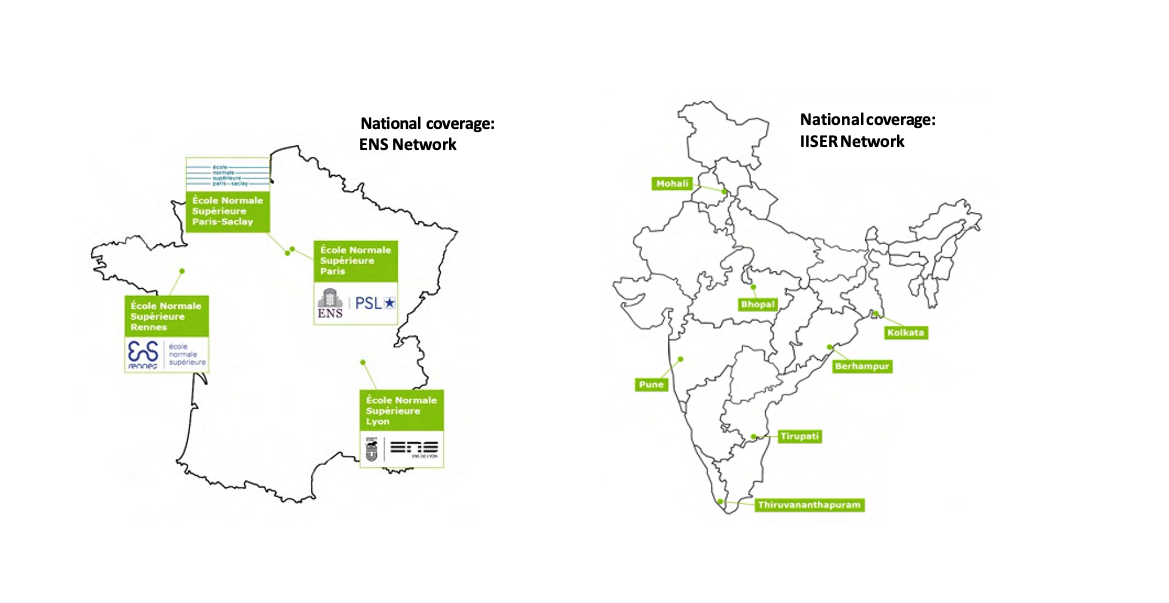
The four ENS in France and the six IISERs in India are two nationwide research-oriented networks of excellence in training and research. They are at the forefront of issues related to societal challenges in terms of health (infectious diseases, cancer, neurosciences, genomics, ecology, bioinformatics, sports sciences, social sciences ...) through the combination of interdisciplinary approaches. They have close links with their respective national research organizations.
The aim of this project is to strengthen the already well-established relationship between these Higher Education Institutions by developing scientific cooperation together with joint programs both at Master and PhD levels in the field of Life Sciences and Health. To support this objective, the network will partner with leading institutes in Health and Social Sciences to provide a broad coverage of the field of Health Sciences and associated challenges. Territorially ambitious, this ecosystem will have sufficient critical size to offer relevant complementarities to develop scientific cooperation in various sub-disciplines and to stimulate interdisciplinary approaches.
The long-term objectives are 1) to establish a sustainable program where research and training are closely linked and mutually nourishing, 2) reinforce Franco-Indian ties by training future specialists (scientists / decision-makers in private and public research in France and India) with a Franco-Indian intercultural competence and capable of working together in a bilateral or multilateral framework throughout their career, 3) gaining visibility for an influence and attractiveness extended to the Indo-Pacific area.
Project description
1. Context and Challenges
1.1 Context and Historical background
The international strategy of the ENS HEIs is based on establishing selective networks with foreign institutions of excellence by linking training programs to research activities and by seeking complementarities. The aim is to contribute together as a collective to address global challenges and issues (including health, climate, sustainable development, ecological transition, etc.). Each ENS and each IISER has its own international strategy, but they come together as a network for specific international projects such as the cooperation project described herein.
India has a very high level of scientific development with highly competent researchers and has been identified in recent years as a key country in the internationalization strategy of the four ENS. In a less and less predictable global geopolitical context, the Franco Indian relationship benefits from a reassuring stability that allows us to envisage long-term cooperation. A rapprochement with the IISERs was initiated in 2017 and an "IISER-ENS group" framework agreement was signed in 2018 to promote both research and training cooperation. The ENS and IISER indeed share similar missions to meet national challenges in terms of training and research, they are highly selective institutions of excellence based on merit, they are comparable in size, they benefit from the most modern equipment and favor inter and transdisciplinary approaches in teaching.
The ENS-IISER network makes it easy to find converging interests or complementarities between all or some of the members, depending on the subject, to pool resources and to benefit from the group effect in order to diversify opportunities and distribute efforts. In the end, this allows for a great flexibility of operation where each partner can take part, to varying degrees, in the network's activities according to its interests or its ability to contribute. Finally, it gives a greater scope and visibility to the cooperation. A trainee exchange
program implemented in 2018 has resulted in the exchange of more than 50 Master's degree trainees to date within the network and this year, 2 joint research thesis projects have started.
1.2 Main characteristics of the ENS-IISER network of cooperation
ENS-IISER: Network of institutions of excellence in France and in India
- Small-size and research-intensive institutions (2000 to 4000 students selected through a highly competitive process)
- High proportion of graduate students (Master-PhD)
- Training and research at the forefront of issues related to societal challenges
- Most of the fields in life sciences are covered by the network (infectious diseases, genetics, cancer, neurosciences, genomics, ecology, bioinformatics, sports sciences, social sciences approaches ...)
- High level of complementarity and interdisciplinary approaches
- Internationally recognized research laboratories
- Close links with the respective national research organizations: e.g. most of research units in the ENS are co-accredited by National Research bodies such as CNRS, Inserm, or INRAe.
Close links and integration within the regional clusters and ecosystems: “COMUEs” and “EPEs” in France, innovation clusters and hospitals in both countries.
1.3 BIOSANTEXC Project: Our vision for a Franco-Indian “Campus in Life Sciences for Health”
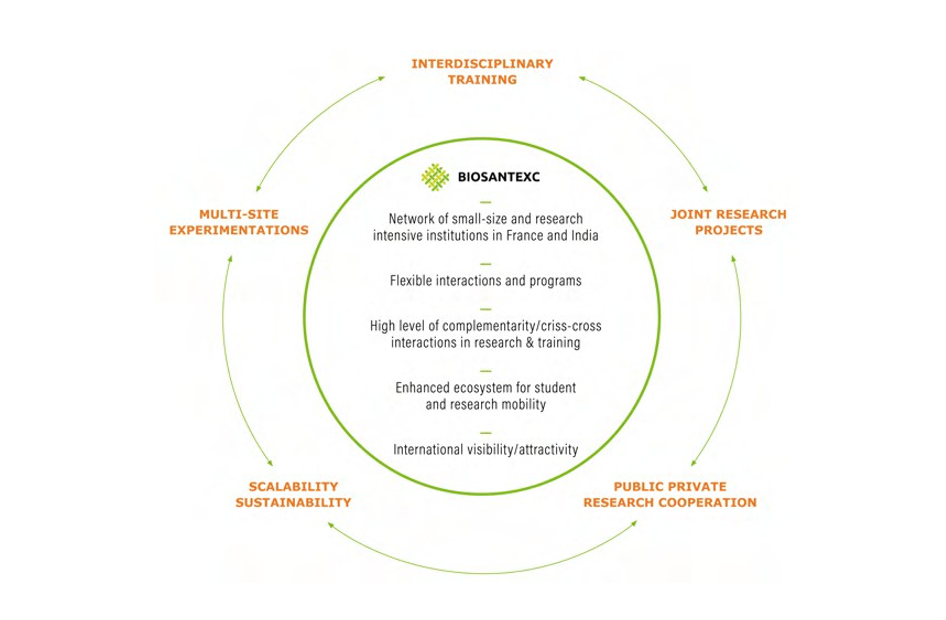
The BIOSANTEXC (BSX) project aims to offer training of excellence to Master and PhD students of the network’s institutions, by relying on its top-tier research laboratories and teaching in life sciences. It will develop opportunities for Master students to engage in study mobility, internships (twinning programs) or double degrees within the network followed by further support at PhD level for high-potential students identified during their Master's degree.
Research and training being inextricably linked, we will invest the same energy to the parallel development of research cooperation through research mobility program and organization of sub-disciplinary and transdisciplinary workshops every year. Our goal is to reach a sustainable ecosystem where future granted joint research projects will provide training opportunities for Master and PhD students and, vice versa, the joint training Master programs will provide well trained students for joint research projects. In this regard, we believe that the size and quality of our network (with new partners) will provide optimal conditions to find the right complementarities both in research and training (a goal much more difficult to achieve in a 1 to 1 institutional partnership).
In terms of influence, the setting up of joint degree programs within the framework of this network of excellence could play a key role in establishing a pole of attractiveness for students of the Indo-Pacific zone.
1.4 Main Partners and Associated Partners
The BSX consortium has been built around the ENS-IISER cooperation network and the National Center for Cell Sciences (NCCS). These “Main Partners” have already shown the capacity to work together and are ready to initiate twinning programs from 2023 and start the first dual degrees by September 2024.
The consortium will benefit from the involvement of “Associated Partners” that are leading institutes in their field with international visibility. Those partnerships will widen the competences and complementarities of the network and provide a global approach towards the challenges, thanks to an even broader coverage of the disciplinary fields.
Associated partners are institutions that joined the network recently. This status allows a progressive integration and better understanding of the already existing network and a graduate ramp-up in the activities. Associated partners will have the opportunity to develop programs with other members and evolve as a main partner within the consortium. They will be able to take part in all the activities of the network at the educational and research levels. They will be fully associated/eligible to participate in scientific workshops, joint research projects, intern/student mobility grant programs and will be able to develop twinning programs/dual degrees within the network. BIOSANTEXC project will also be open to welcome new associated partners, namely from the Indo-Pacific region. Specificities of each partner and associated partners are detailed in section 3.
2. Key achievements by the end of the project and 5-year vision
2.1 General goals
- To build a Franco-Indian cooperation ecosystem of excellence in Life Sciences constituted of 14 leading and internationally recognized institutions to begin with.
- To create a highly flexible space of exchanges to stimulate complementarities, interactions and innovation in research and students training, and to strengthen existing ones.
ü Reinforce Research Cooperation: In order to increase the chances of finding adequate complementarities in several disciplinary subfields, the size and quality of the BIOSANTEXC ecosystem is essential to develop various cooperation projects at researchers/teams scale.
ü Create favorable conditions for reciprocal student mobility in the ecosystem (from stimulating programs and projects to mobility grants with guaranteed on-site accommodation).
ü Gain international visibility to attract funding for research projects and student mobility programs.
- Develop interdisciplinary approaches that strengthen the Social Sciences element of the proposal (through the partnership with TISS and Human/Social Sciences Departments of the BSX consortium.
- Train future specialists / decision-makers in private and public research with global awareness,
ü With Franco-Indian intercultural skills
ü Having collaboration networks in both countries
ü Being able to maintain bilateral and multilateral collaboration during their career.
- Take advantage of the complementarity of approaches/develop crisscross interactions
- Develop connections with industry and promote entrepreneurship
- Encourage the association of partner institutions in France, India and abroad.
2.2 Four categories of key objectives and activities within the next three years
(1) Increase the flow of mobility at the Master's level (study mobilities / internships)
- Recognition of the international exchange through (in ascending order)
ü Certification for exchange mobilities in the network: Very short term (end of 2022) – temporary procedure before developing twinning programs (see section 4.1 for details)
ü Twinning programs: short term – These programs will recognize the international experience at a partner institution in the diploma of the home institution. The first agreements between most institutions (initially on a bilateral basis for simplification) are planned to be achieved for Spring 2023, discussions have already been initiated and no major difficulty is expected given the NEP guidelines for including these kinds of programs. However, the timelines could vary between the various IISERs.
ü Double diplomas (mid to long term) – A first double degree at the Masters level is expected before sept 2024 (see section 4.1 for details).
- The pioneer members of the network that will first develop twinning programs and/or double degree will share their experience and best practices with other partners.
- Prioritize disadvantaged students and give special attention to gender equality and social equity in the selection processes.
(2) Promote doctoral mobility by setting up dedicated programs
- Dual PhD degrees (co-tutelles) will be encouraged (see section 4)
- Co-supervised PhD theses should be more readily possible
- Excellent Master students of the BSX network will be identified for PhD opportunities
- Develop “Master-PhD tracks” for co-supervised/dual PhDs – selection of best students during their Masters
(3) Organize four scientific meetings (both on subdisciplinary fields and on interdisciplinary approaches/ global issues linked to Health). This will be done alternatively in France and in India during the two years of the project.
- To stimulate interdisciplinary research / projects
- To stimulate collaborations around Sustainable Development Goals assigned by UN
- To connect researchers in their disciplinary fields
- To identify complementarities
- Share, within the network, good practices and previous successful experiences with CEFIPRA and other international projects involving France and India.
(4) Visiting faculty programs
- Short (1-2 weeks) Research and Teaching mobilities to develop scientific cooperation
- Development of remote classes/projects with pedagogical engineering support (such a class already exists in Chemistry for Biological Systems between IISER Pune and ENS de Lyon)
- Optimize existing visiting Professors programs of each institutions to target annual positions for this network.
The objectives in a five-year timeline are to build a strong basis (in education and research) to attain a viable ecosystem based on an education network at Master’s degree that will feed into Franco-Indian bilateral or multilateral research projects with PhDs students (co-supervision or co-tutelles). Development of scientific cooperation and increased visibility of the network will attract more research funding for PhDs / postdoc positions. The network will apply to international mobility programs (such as Erasmus KA 171, Raman Charpak) to sustain student mobility at the Masters level.
The increased visibility of the network will attract best students by providing them the opportunity to join this Franco Indian program to get double degrees/experience that will maximize their chances to get doctoral offers within or outside the network.
3. Inventory of institutions involved with regard to project objectives
3.1 List of institutions involved
Main partners
§ 4 ENS (Écoles Normales Supérieures) institutes: Lyon, Paris, Paris-Saclay, Rennes
§ 6 IISER (Indian Institute of Science Education and Research) institutes: Bhopal, Kolkata, Mohali, Pune, Tirupati, Thiruvananthapuram
§ NCCS (National Center for Cell Science) institute
The Main partners (as explained in part 1) have already demonstrated the capacity to work together and know each other well. They are ready to initiate twinning programs from 2023 and some partners plan to start dual degrees before the end of 2024. They constitute the steering committee of the project.
They all have excellent training and research laboratories in Life Sciences widely covering the subdisciplinary fields and use interdisciplinary approaches through other disciplines (Mathematics, Chemistry, Physics, Social Sciences etc..) with high level of complementarity.
Associated partners
Three Indian institutions of excellence are associated partners for this call for proposal.
§ NCBS (National Center for Biological Sciences)
§ NIBMG (National Institute of Biomedical Genomics)
§ TISS (Tata Institute of Social Sciences)
The Associated Partners will complement the expertise of the consortium since the BSX project is open to life sciences related projects of all disciplines, including Social Sciences. The Tata Institute of Social sciences will contribute by providing opportunities in interdisciplinary areas related to environmental sustainability, ethical questions pertaining to health (and allied areas) or field projects.
This status allows a progressive integration and better understanding of the already existing network and a graduate ramp-up in the activities (see section 1) with the possibility to become a main partner. They will be fully associated/eligible to participate in all the programs and activities of the network. New associated partners could also join the network after the steering committee’s agreement.
Bilateral exchange agreements (for Master students mobilities, on the principle of Erasmus+ agreements) process has begun and will be signed progressively between main partners and associated partners.
3.2 List of existing capacities of each project partner and courses
(Please see Appendix 4 for a more detailed list of degrees/courses and calendar/procedures for mobility applications. This selection of training curricula may continue to evolve according to new training opportunities that will arise during the period).
ENS de Lyon
The Master's training offer is largely fundamental, generalist and of high level, it is oriented towards genetic cellular and molecular mechanisms at multiple scales including computational and modelling, in direct link with the themes developed in the 4 biology laboratories located at the ENS de Lyon: International Center for Research in Infectiology (CIRI), Laboratory of Biology and Modeling of the Cell (LBMC), Institute of Functional Genomics of Lyon (IGFL), Laboratory of Reproduction and Development of Plants (RDP). All of them working in close collaboration with research organizations (Inserm, Pasteur Institute, INRAe etc..) and the BSL4 laboratory of Lyon. The transdisciplinary approach, as in the other ENS, is at the heart of the training.
ENS Paris
The IMALis Master's degree offers a first-rate interdisciplinary training in life sciences oriented towards research in the fields of genomics, bioinformatics, neuroscience, ecology, evolution, and fundamental biology for health. Courses are taught in partnership with renowned institutions such as the Collège de France, the EPHE, the Institut Pasteur, the Institut Curie, etc.
ENS Rennes
The training offered in Sport Sciences is based on a dual approach through the Life and Health Sciences, and the Human and Social Sciences. The training in Life Sciences for Health is divided into 3 principal axes. The first axis covers the study of cardiovascular and metabolic responses according to the level of physical activity. The second axis focuses on the study of biological mechanisms and physio-pathological adaptations for the optimization of physical activity modalities with a focus on chronic diseases, in particular cancer and peripheral artery disease. Finally, e-health and digital innovations for tomorrow's physical activity and sports performance constitute the third axis. The ENS Rennes belongs to the EUR (“Ecole Universitaire de recherche”) DIGISPORT, which provides a facilitating environment for research.
ENS Paris-Saclay
The training courses related to life sciences are based on research activities that are themselves very varied, for applications in health, such as the study of molecular mechanisms linked to various pathologies, optical methods for the living, computational biology, and mathematics for neuroscience. These activities are deployed within the institution's laboratories (notably the Institutions and Historical Dynamics of the Economy and Society laboratory - IDHES, the Laboratory of Biology and Applied Pharmacology - LBPA, the Light, Matter and Interfaces laboratory - LuMIn and the Borelli Center).
IISER Pune
Training and research are focused on a series of topical and cutting-edge areas related to biological systems. The main disciplinary areas encompass a very wide swath of biological sciences and are broadly divided as follows: 1. Biomolecular structure, function and organization, 2. Cellular, organic and developmental biology,
3. Chromosome biology and epigenetic regulation, 4. Ecology and evolution, 5. Neurobiology and behavior,
6. Computational biology.
National Center for Cell Sciences (NCCS)
The National Centre for Cell Science (NCCS) was established to facilitate cell biology research in India. It performs cutting-edge research in cell biology, providing valuable services as a national animal cell repository, and supporting human resource development through various teaching and training programs. The research at NCCS is focused on answering these challenging health issues through approaches that integrate modern and conventional disciplines including cell biology, cellular signaling, stem cell biology, immunology, genomics, proteomics, systems biology, structural biology and microbial ecology. NCCS and IISER Pune are members of the Pune Biocluster. NCCS has a close and long-term relationship in research with IISER Pune through the Pune Biotech Cluster.
IISER Tirupati
Teaching and Research is focused on infectious diseases (Tuberculosis, Malaria and Avian Malaria in particular) equipped with a P3 laboratory which will be operational from Dec. 2022, cancer (mechanisms, signaling and clinical diagnosis), developmental biology and neurodegenerative diseases, chromosome biology, structural and systems biology.
IISER Bhopal
Its main strengths are virology, cancer research, epigenetics, RNA biology, immunology, plant molecular biology, chemical biology, genomics, ecology, evolution, microbiology, biomedical devices and engineering. BSMS students and doctoral students in the Department of Biological Sciences have access to state-of-the- art research facilities. To encourage interdisciplinary research and foster ideas from other disciplines a new center of excellence (the Medical Science and Engineering Research Center (MEDSER)) has been established to foster and support research programs in the life and health sciences.
IISER Kolkata
Training and research cover the discipline from the molecular to the whole organism level with an interdisciplinary approach. Major areas include cell and molecular biology, developmental biology, neurobiology, computational biology, structural biology and biophysics, environmental biology, animal behavior and ecology.
IISER Mohali
IISER Mohali is active in the domain areas of immunology, virology, cell and molecular biology, neurobiology, behavior and evolutionary biology, epigenetic regulation, stem cells and tissue regeneration, proteins: experimental and theoretical approaches, developmental biology, genetics and metabolism, signaling and metabolic requirement of stem cells, retina regeneration through zebrafish, protein engineering, protein folding and misfolding, etc. The faculty members have ongoing collaborations all across the globe. Masters' students are encouraged to engage themselves in student mobility programs while pursuing their yearlong master thesis.
IISER Thiruvananthapuram (TVM)
Research in Biological Sciences at IISER TVM spans all scales from single molecules all the way up to ecosystems. Its school of biology covers the fields of Microbiology, Genetics, Developmental and Neurobiology, Ecology, Cellular and Molecular Biology. It has very strong research themes open for collaborations within the network such as targeted drug delivery, high throughput analysis of genomic instability or emerging infectious viral diseases.
Associated Partners
National Center for Biological Sciences (NCBS)
The National Center for Biological Sciences (NCBS) is a center of the Tata Institute of Fundamental Research, where scientists conduct fundamental research in the life sciences. The NCBS also builds scientific capacity by training PhD and integrated PhD students in diverse areas of biological sciences including but not limited
to cell biology, infectious diseases, neurobiology, ecology, evolution, developmental biology. It also hosts a Master program in wildlife biology and conservation. These research topics are explored across scales ranging from atomic to ecosystems, using a wide variety of systems and model organisms, through excellent research facilities. The NCBS is within the Bangalore Life Sciences Cluster, that also includes InStem (Institute for Stem Cell Science and Regenerative Medicine), CCAMP (Centre for Cellular and Molecular Platforms), and TIGS (Tata Institute for Genetics and Society)".
National Institute of Biomedical Genomics (NIBMG)
The NIBMG is an interdisciplinary training and research on genomics of human health and disease. Genetic mechanism of deep phenotype through multi-omics approach for chronic and infectious diseases, cancer, statistical Genomics, data analytics, genomics alterations in relation to environmental exposures. NIBMG is a National Core center for high throughput Genomics. The academic programs are carried out in collaboration with clinicians to provide appropriate exposure to methods of clinical phenotypic. It also holds hands-on skill- development programs for external institutions and specialized integrated Master training program for biomedical genomics. NIBMG is already a strong partner of IISER Kolkata.
Tata Institute of Social Sciences
The School of Health Systems Studies (SHSS), Tata Institute of Social Sciences (TISS), is an interdisciplinary research center with over 40 years of experience in advancing research in public health, and health systems (including health policy, health economics). SHSS offers interdisciplinary post-graduate programs in public health and health service system. The school prepares students for research, policy analysis, and health care practices in the field of public health. SHSS looks at health issues using the lens of social determinants of health framework and is engaged in research that seeks to understand the major public health challenges of the country, the structural constraints that people, especially the marginalized sections, face in accessing the health services, and it contributes to advocacy work that promotes health equity. SHSS provides opportunities of cross-cultural experiences on public health issues through field-based Internships and through seminars. SHSS also offers SIP-Field Practicum in Social Care Policy and Practice.
A few (non-exhaustive) examples of complementarities
- Sport sciences are a specificity of ENS Rennes that develops them through the Life and Health Sciences (physiology and biomechanics) and the Human and Social Sciences (history, sociology, psychology and educational sciences) approaches.
- The four ENSs, by essence, have the capacity to develop interface projects in many domains such as biophysics, data sciences for biology, Social sciences, etc. and will bring this diversity into the network. For example, the Rhone-Alpes Institute of Complex Systems (IXXI) located at ENS de Lyon is dedicated to the promotion of research at the crossroads of different disciplines to address contemporary challenges and can take part in the activities of the network.
- The Institute of Functional Genomics of Lyon (IGFL) is an international research unit dedicated to fundamental research on the role of the genome in animal development, physiology and evolution with a strong focus on integrative, organism-level research using a diversity of conventional model and emerging model organisms. Research at the IGFL already finds complementarity with many IISERs including IISER TVM with the potential for synergy in the fields of evolution, development and physiology and research at their interfaces. IGFL has hosted many masters and PhD students from IISER Pune, Tirupati and Bhopal in the past 5 years. The IGFL management team will be visiting IISER TVM in Fall 2022/Spring 2023.
- IISERs or TISS propose field projects linked to health sciences that will greatly benefit to French students (For example, at IISER Bhopal, students work with local villages on specific programs such as biological alternatives to fields burning).
3.3 Pre-existing partnerships and experiences between institutions participating in the project
- Existing framework agreement for cooperation between all the IISER and ENS signed in 2018, will be renewed in 2023.
- Under this agreement, an exchange program for Masters level research internships is running since 2018. Selected interns get free accommodation at the host institution and a living allowance (internship gratification in France) + financial help for travel expenses from their home institution.
ü >50 IISER interns have been hosted at ENSs since 2018. Each ENS offers 3 stays of 3 months (internship stipend + accommodation) every year for IISER students.
ü Reciprocity is gradually taking hold after Covid-19 restrictions, 29 internship proposals were offered to ENS students in 2021 but mobility has remained modest due to the pandemic context. Two ENS Rennes + one ENS Paris students have been selected in 2022-2023 for internship and student mobility at IISER Bhopal and Pune as of January 2023.
- The goal of this internship program is to identify students for PhD proposals within the ENS – IISER network. PhD theses are already in progress. For the academic year 2022-2023, two IISER Tirupati students have started a PhD at ENS Lyon (one in the laboratory of Biology and Cell modeling, the other at the Institute of Functional Genomics) after successfully completing an internship in 2021- 2022 through our Master internship program.
- Teaching assistant: a French lecturer from ENS Lyon was posted at IISER Pune for the academic year 2019-2020. IISER Tirupati has opened a position for a French language assistant from ENS.
- Regular official delegation visits take place within the network:
ü Official IISER delegations received in France in 2017 and 2019
ü ENS institutional missions in India in 2016, 2018 and 2019 (with presence of the Presidents of the ENS)
- Participation in bilateral cooperation / Organization of events
ü Active involvement of IISERs and ENSs in the 2018 and 2019 Knowledge Summits.
ü An IISER-ENS meeting organized in Lyon (2019) to exchange on cooperation perspectives with a half-day dedicated to specific disciplinary meetings in the laboratories.
ü An inter ENS-IISER workshop was organized remotely in 2021 with the support of the French Embassy in India on Pedagogy and Online Teaching Practices (see program in Appendix). Participation of a representative of the French Ministry of Higher Education, Research and Innovation, for a presentation of the French digital strategy for higher education.
- A dozen of Indian visiting professors have been hosted in the different ENS since 2016 and numerous missions of researchers were organized in both ways (not all are actually known at institutional as new links between our researchers are regularly identified).
- Examples (non-exhaustive list) of pre-existing scientific exchanges and successful bids
ü Pr Chaitanya Athale (IISER Pune) CEFIPRA Project 2019-2022 with Pr Marie Delattre (Laboratoire de Biologie et de Modélisation de la Cellule - LBMC laboratory at ENS de Lyon) in biophysics/cellular biology + CNRS PhD grant on this project.
ü Pr Abhijit PATRA (IISER Bhopal) CEFIPRA project 2022 in chemistry with Pr Rémi Métivier/Pr Keitaro Nakatani (ENS Paris-Saclay- PPSM laboratory)
ü Pr Satyajit Mayor (NCBS, Bangalore) with Dr Muriel Grammont (LBMC, ENS de Lyon): ANR grant coordinated by M. Grammont starting March 2023 to 2026.
ü Dr N.G Prasad (IISER Mohali) with Dr Henrique Teotonio (Institut de Biologie de l’ENS - IBENS, ENS Paris) on evolutionary biology.
ü Samir Merabet (IGFL, ENS Lyon) with L Shashidhara (IISER Pune) on functional genomics (CEFIPRA 2016-2019).
ü Pr Amrita Hazra (IISER Pune), invited Professor at ENS de Lyon in 2018-2019 and 2022-2023.
ü Pr Sudha Rajamani (IISER Pune) CNRS PICS funding (PICS INDE 2017-2019, PICS07501) with Pr Julien Derr (ENS Lyon).
ü NCBS has strong research relationship with ENS Paris.
- Erasmus+ projects: an ENSs-IISERs "Consortium Accreditation" (KA130) has been validated for the period 2021-2027. Common application will be made for the next call for project to support international mobility.
4. Training courses and main activities foreseen
4.1 Training courses
As mentioned in the previous sections, the project consists in creating favorable conditions for mobilities within the ecosystem of partner institutions in the field of life sciences applied to health. At first, bilateral agreements (internships, student mobility, twinning programs, double degrees) will be preferred to multi- partners agreements in order to ease the process and to develop them in a short timeframe. These agreements will then serve as examples for other partners.
Internship twinning program
The internship program that has been implemented since 2019 with a common calendar for all members of the network (see figure below that summarizes the calendar for the India to France mobility) will evolve within the first months of the project into a twinning program through the recognition of the international mobility by the home institutions in their own Master/PhD diploma.
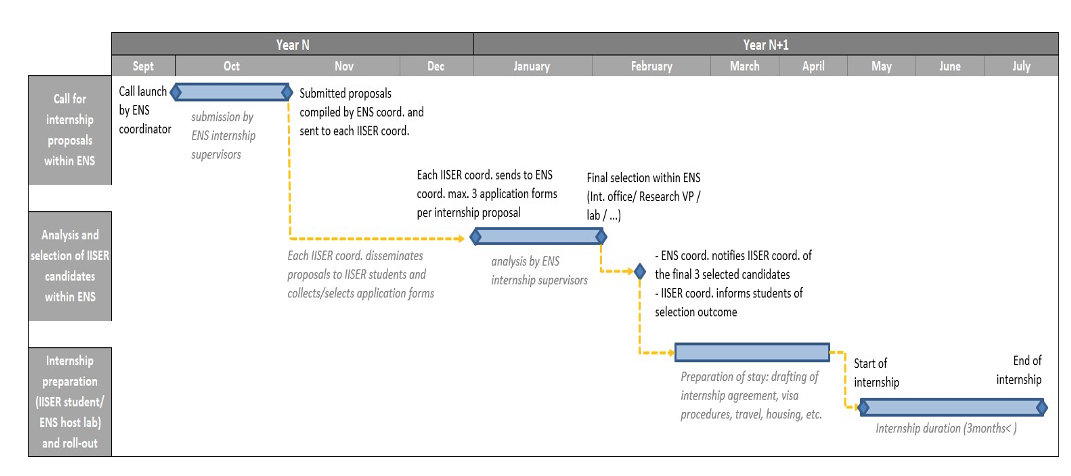
In the meantime, before twinning program implementation that first need Indian partners Senates approval), all host institutions will provide a certificate to students that recognize their international experience within the Indo-French campus in life sciences.
The program will benefit to up to 24 Indian students per year (12 financed through this program and 12 financed by the already existing program) and to 12 ENS students per year (8 financed through this program and 4 through other mobility grants from institutions). Free on campus accommodation (at the cost of host institution) will be provided to all students.
Study mobility
1- mobility certificates and twinning programs
Study mobilities will be encouraged through a specific program similar to Erasmus+ study mobility schemes. Agreements will progressively be established between partners with a process of applications for semester or year mobilities.
Following the same procedure as for the internships, certificates will be provided by host institutions during the first months, in order to recognize the students international experience within the network, the time that Senates of partner institutions approve those mobilities as part of twinning programs (recognition of the international mobility by the home institutions in their own Master/PhD diploma).
This extension to twinning program to student mobility will be implemented gradually by the partners during the year 2022-2023. No major difficulty is expected given the 2020 Indian National Education Policy (NEP) guidelines.
Example of eligible mobility within a twinning program for an IISER Master student in an ENS Master:
A learning agreement will be made prior to the mobility between the student, the French and Indian disciplinary coordinators in a similar way to Erasmus+ mobility agreements. At the end of the mobility, the host institution will send transcripts to the home institution that will decide (according to the results) to validate the mobility in its Master diploma (accord to credits obtained).
2- Double Diploma at Master level
A first double degree at Master level (students will get two diplomas) between two pilot partners is expected before Sept 2024. As IISERs will need approval of their Senates and Board of Governors, they are already in the process of informing them about the project of double diplomas. IISER Pune and ENS de Lyon have already initiated preliminary discussions (see Appendix 3). Pedagogical teams will need one academic year to reach reliable study schemes (with conversion of credits, identification of eligible teaching units lists and time spent in each institution) and make them approved by their institutions (Senates, councils). IISER Pune has a previous experience of double diploma with French institution as they already implemented one with IPGP (Institut de Physique du Globe de Paris).
We make the choice to build double diploma from our extensive offer of existing Masters, their complementarities and strong articulation to a wide area of research domains (and PhD opportunities), rather than create new joint Masters that would rely on a narrow thematic domain and would make their sustainability at risk.
3- Double Diploma at Doctoral level
Administrative staff of BIOSANTEXC project partners will start during fall 2022 to share their own co-tutelle agreements and working groups will be organized during the academic year 2022-2023 to design a common general template that will serve as a basis to facilitate new co-tutelles. First co-supervised/co-tutelle PhDs are expected in 2024. All partners have already a strong experience of international co-tutelles.
General remarks:
- The ENS network has a strong experience of international joint Master-PhD program (“Prosfer” Program) with East China Normal University (ECNU, Shanghai): Students are selected in a specific track during their Master with Sino-French education, the best ones being selected for co-tutelle PhDs at the end of the Master. More than 100 PhDs have been defended in 20 years and 50 more are still in progress That makes it the biggest and most productive joint doctoral program between France and China. The “Joriss” (Joint Research Institute for Science and Society) program is closely linked to Prosfer by co-financing joint research projects between two teams that have a PhD student in co-tutelle.
- The pace of structuration will not be the same for all members of the network. Some of them may need more time but will benefit from the experience and good practices of other partners. The number of partners with common interests/missions and the flexibility provided by the network are good guarantees of success
in the structuration of the programs. In addition, the very recent modification (May 2022) of the Indian law allowing twinning programs will facilitate the implementation of twinning programs within reasonable time.
- A critical objective will be to detect and retain early the best Master students and offer them PhD positions (in co-direction or co-tutelle) within the ENS-IISER network. In this sense, the parallel development of research collaboration (through thematic workshops) and the ability to set up call for proposals for co- financed theses will be central for the success of the program in the long term.
We hope to implement this virtuous system in which joint research funding will allow the financing of PhD theses at a 3-5 years horizon. These doctoral programs will be fed by international mobility at the Master level, itself co-financed by programs such as Key Action 171 of the Erasmus+ program.
4.2 Main activities at the research cooperation level
We believe that the co-development of scientific collaborations in parallel with education at Master/PhD levels is essential for the viability and sustainability of long-term programs. That’s why we choose from the beginning of the project, to set up actions to promote these two aspects in parallel.
- Scientific workshops
Four scientific workshops/events will be organized within the two years of the project, alternatively in Indian and in France. The aim is to have in each of them a session dedicated to contemporary global challenges in health or life sciences followed by sub-disciplinary sessions. These workshops will also be open to students in order to connect them with researchers. In case of success, a kick-off event will be held during spring 2023 in India (exact moment to be defined with the French Embassy in India) where the first twinning program agreements will be signed in presence of the Presidents and Directors of all BSX project partners. It will also be the opportunity to have a signature ceremony for the renewal of the general agreement between the IISERs and the ENSs.
A scientific conference will be part of this kick-off event.
- Research visit program
The research visit program (1-2 weeks) that will be launched coming November for visits starting next January will allow French and Indian scientists to visit partners (or prospective partners) in one or several institutions of the BSX network. Applicants will have to pre-identify researchers that they would like to meet (or preexisting contacts for exchanging on research projects) and provide a justification. Successful applicants will also be oriented towards other laboratories or research units relevant to their scientific fields to visit them and give scientific seminars.